Skip to content

Choosing a shockwave system is a big decision. Let's make sure you feel good about it.

What you choose impacts what you can treat, how effectively you treat it, and how quickly you see ROI.

What actually impacts your results

Most systems look similar until you start treating real cases. Depth, precision, and control determine what you can treat and how effective it is.

When you compare systems, the most important differences are the ones that affect what you can treat, how precisely you can treat it, and how consistently you can reproduce results.


Depth & Penetration

Limits or expands what conditions you can treat

02

Precision & Focal Control

Determines consistency and clinical outcomes

03

Energy Output

Impacts ability to treat complex cases

04

Flexibility Across Cases

Allows adaptation across patients and conditions

Equine Shockwave Therapy Guide

A Practical Clinical Reference for Precision Treatment

This comprehensive guide is designed to help equine practitioners apply shockwave therapy with confidence and precision. It covers the fundamentals of piezoelectric technology, including how depth, focal zones, and energy settings directly impact treatment outcomes. From there, it moves into real-world clinical application, offering structured guidance on treating common equine conditions, selecting the right therapy source, and optimizing dosing based on patient response.

Built from clinical experience and supported by research, the guide emphasizes a key advantage of focused shockwave: the ability to control penetration depth, intensity, and targeting independently. This allows for more accurate treatment of both superficial and deep structures, improving consistency and expanding what you can treat in practice

Equine Guide Thumbnail

See what this looks like in your practice

At this stage, the decision comes down to two things.
Will it work in your cases? And will it make sense financially?

Cost of ownership + revenue impact

Shockwave ROI Calculator

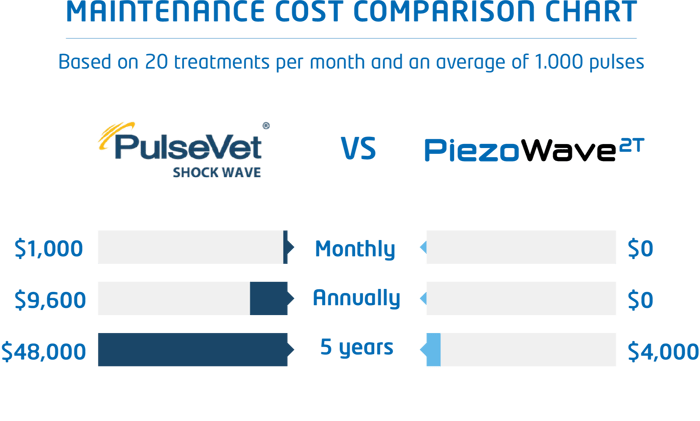
Compare trode refurbishment costs and long-term profit impact of PulseVet vs. a fixed-cost PiezoWave2T system.

Your practice inputs

Typical range: 1,000–2,000 pulses per area
Average monthly shockwave volume
 

System assumptions

Refurb/exchange: ~$1,795–$2,000 per trode (50k pulses)
Fixed annual cost, no per-pulse charge

Results

Profit lost to trode refurbishments (5 years)

Enter your practice details and click Calculate.

 PulseVet
Monthly cost
Annual cost
5-year cost
Trode refurbs / month
 PiezoWave2T
Monthly cost
Annual cost
5-year cost
Per-pulse cost$0

Monthly rev.

Annual rev.

5-year rev.

Methodology: PulseVet cost is modeled as usage-based trode refurbishments at the entered cost per trode (50,000 pulses each). PiezoWave2T is modeled as a fixed annual maintenance cost with no per-pulse charge. For planning purposes only — actual pricing, protocols, and utilization may vary.

Request More Information

Comparing PulseVet?

If PulseVet is on your shortlist, take a closer look. See how differences in technology translate to real clinical performance and treatment capability. 

Comparing CS Pro?

Before you decide, see how the two systems actually compare — from treatment depth to day-to-day usability. The differences are worth understanding.