
Don’t Miss the Foot: A Practical Approach to Canine Distal Limb Lameness (Plus Shockwave Case Examples)
Forelimb lameness can feel straightforward until it isn’t. Shoulder, elbow, and carpus are common culprits, but distal limb pain can hide in plain sight, especially in active dogs and sighthounds. In a recent open forum, Dr. Melissa Franssen shared a structured way to localize distal limb pain and illustrated it with case examples treated using extracorporeal shockwave therapy. She also made an important point up front: the literature is still limited, so this is an invitation to learn together and build better clinical clarity.
Why distal limb localization matters
A recurring theme in the forum is simple: the better you localize, the better you treat, and the more efficient your diagnostics become. Dr. Franssen’s goal is to help clinicians move from “left thoracic limb lameness” to a tighter suspected structure, so palpation, imaging, and therapy can be more targeted.
Start with a repeatable exam flow
When presented with a forelimb lameness, Dr. Franssen recommends screening broadly, then narrowing fast:
- Rule out cervical pain and nerve root signature
- Consider shoulder injury patterns in sport dogs (she notes shoulder injuries are commonly reported in agility dogs)
- Evaluate elbow, including the Campbell’s test for medial coronoid pain (after you’ve screened the carpus to avoid misleading results)
- Examine the carpus for heat, swelling, effusion, and normal range of motion
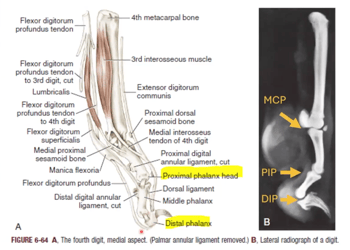
- Do not stop there. Palpate metacarpals and digits, check sesamoids, and assess Metacarpophalangeal joint (MCP), Proximal interphalangeal joint (PIP), and Distal interphalangeal joint (DIP).
- Remember derm and nails, including painful nail bed injuries that can look like “mystery lameness”
Digit stability testing: a small step that changes everything
A practical detail that comes up repeatedly is how to test digit collateral stability correctly. Joint position matters. For valgus/varus stress at the digit joints, Dr. Franssen stresses that the joint should be in extension. Comparing both sides and paying attention to end-feel (and pain response) can help you decide whether you are dealing with instability, inflammation, or something else.
 Toe posture clues: DDF vs SDF injuries
Digit injuries are not limited to collateral ligaments. Dr. Franssen also highlights how superficial and deep digital flexor injuries can change toe position. A “popped up” toenail can suggest deep digital flexor involvement. A flattened PIP can suggest superficial digital flexor involvement. Even if you do not make a final diagnosis from posture alone, it can guide your hands and your imaging.
Case example 1: Recurrent digit instability in a Greyhound
Ramona, an 8-year-old Greyhound, had recurrent right forelimb issues with swelling and significant valgus instability at the PIP joint of digit five. Options discussed included prolotherapy, steroid injection for comfort, shockwave, and surgical considerations such as arthrodesis or digit amputation (with owner counseling about biomechanical consequences). They chose a least-invasive approach: shockwave paired with immobilization strategies.
A key practical lesson here was not just treatment, but management. Buddy taping helped stabilize the digit, but sighthound skin presented challenges. Elastikon caused abrasions, KT tape was tried, and later a boot with a firmer base became a better solution as rubbing and skin breakdown emerged. On recheck, the digit was not “perfect,” but was more stable and, most importantly, comfortable and functional again.
Case example 2: Intermittent lameness in a Whippet agility athlete
Winnie, a 3-year-old Whippet, showed left forelimb lameness primarily during sharp turns and agility maneuvers. Exam findings pointed to digit five PIP thickening and pain with flexion/extension. Shockwave was performed once weekly for three sessions. At recheck, the toe was notably more comfortable, and the remaining intermittent lameness was ultimately associated with a triceps trigger point. The plan then shifted to progressive reloading and controlled engagement work, moving from straight-line activity toward carefully introduced load and uneven surfaces over time.
Case example 3: Medial carpal swelling and abductor pollicis longus tenosynovitis
Ghost, a 2-year-old Labrador, presented with acute medial carpal effusion and marked pain after chasing wildlife. Diagnostics (radiographs and ultrasound) supported abductor pollicis longus tenosynovitis (also described as “hitchhiker thumb”). Dr. Franssen notes that published veterinary treatment data is sparse and describes older approaches such as analgesia, steroid injection plus coaptation, or surgery in cases that fail conservative management. In this case, she chose shockwave as a least-invasive option, using ultrasound to measure depth and guide setup, and reports significant improvement across the treatment series with a normal gait analysis and improved ultrasound appearance on recheck.
A final note on sport dogs: substrate, nails, and injury risk
The forum closes by widening the lens. Dr. Franssen references survey-based agility studies and discusses how factors like long nails and ground substrate may influence injury patterns. She also emphasizes how many variables exist (wet vs dry grass, grooming, temperature, and slip risk), and encourages clinicians to keep asking better questions while contributing to broader data collection efforts.
Takeaway
If you want fewer “unknown origin” forelimb lameness cases, look down. Digits, nails, and distal soft tissue structures deserve a consistent place in your exam flow. And when shockwave is part of your toolkit, precise localization and thoughtful immobilization strategies can make your treatments more targeted and your outcomes easier to track.
📹 Watch the presentation now
📹 Watch the presentation now